Tank or tankless water heater for a Connecticut home
Send the form and stop researching installers for the new water heater.
A water heater does not announce when it is near the end. It just starts costing more to run, or it runs out of hot water sooner than it used to. If yours is on its way out, or you are building a house and have to pick one, the tank-versus-tankless question is one you answer once and live with for years.
Connecticut electric rates are among the highest in the country, and that changes the math more than it does in most states. A tank keeps forty or fifty gallons hot around the clock, whether anyone uses it or not. A tankless unit heats water only when a faucet is open. Over a year, that difference shows up on the bill in a way it might not where power is cheap.
Space matters too. A tank needs a few feet of floor, usually in a basement or utility closet. A tankless unit mounts on a wall and gives that floor space back, which counts for something in a smaller house or a finished basement.
Picking the right one means knowing your household's hot water habits, your gas or electric setup, and what the install actually involves, things that are hard to judge from a search bar. That is the part a licensed local plumber can walk you through in minutes, once you decide to ask.
Send the form below and the job of finding someone stops being yours. No more calling plumbers one by one, explaining the same thing each time, waiting on callbacks, trying to compare quotes that are not even for the same equipment. That work goes to the page instead of you. A local, licensed installer gets your details and takes it from there.
For most Connecticut homes, a tank water heater is still the simpler choice, and tankless earns its keep mainly when gas line and venting are already in place or you are building new. Tankless units heat water on demand, so you are not paying to keep forty or fifty gallons hot around the clock, which matters here since power is among the most expensive in the country. But a tankless unit costs more to install, and if your home runs on electric only, the gains are smaller than the sales pitch suggests. A tank is cheaper upfront, easier to replace like for like, and still the better fit for a lot of houses here. Tankless pays off faster for a household that runs hot water hard, showers back to back, a dishwasher and laundry going at once. For a smaller household, it may take years to make up the difference in what you paid to install it.
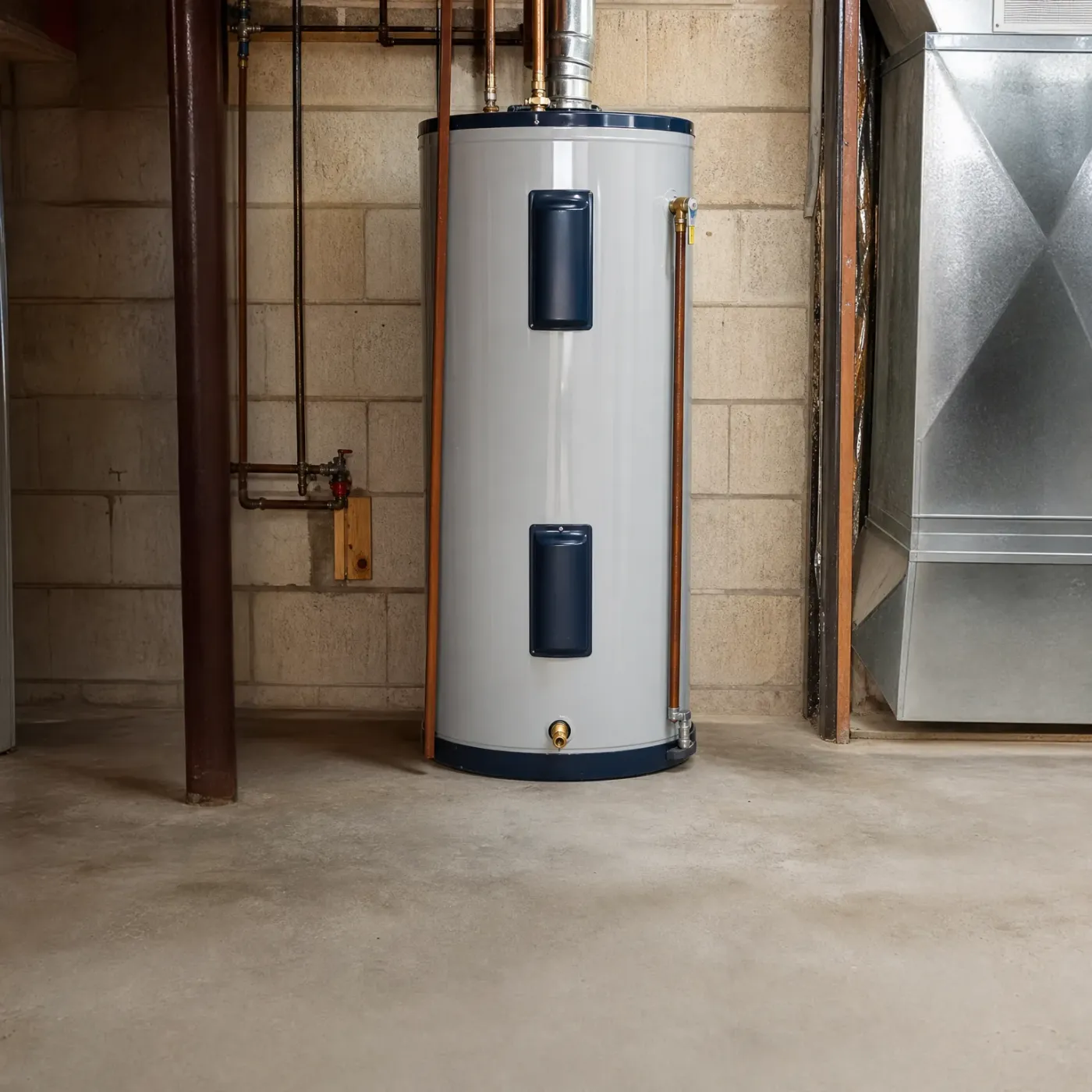
A tank water heater that's doing its job: no rust at the seams, no corrosion on the fittings, connections dry and solid.
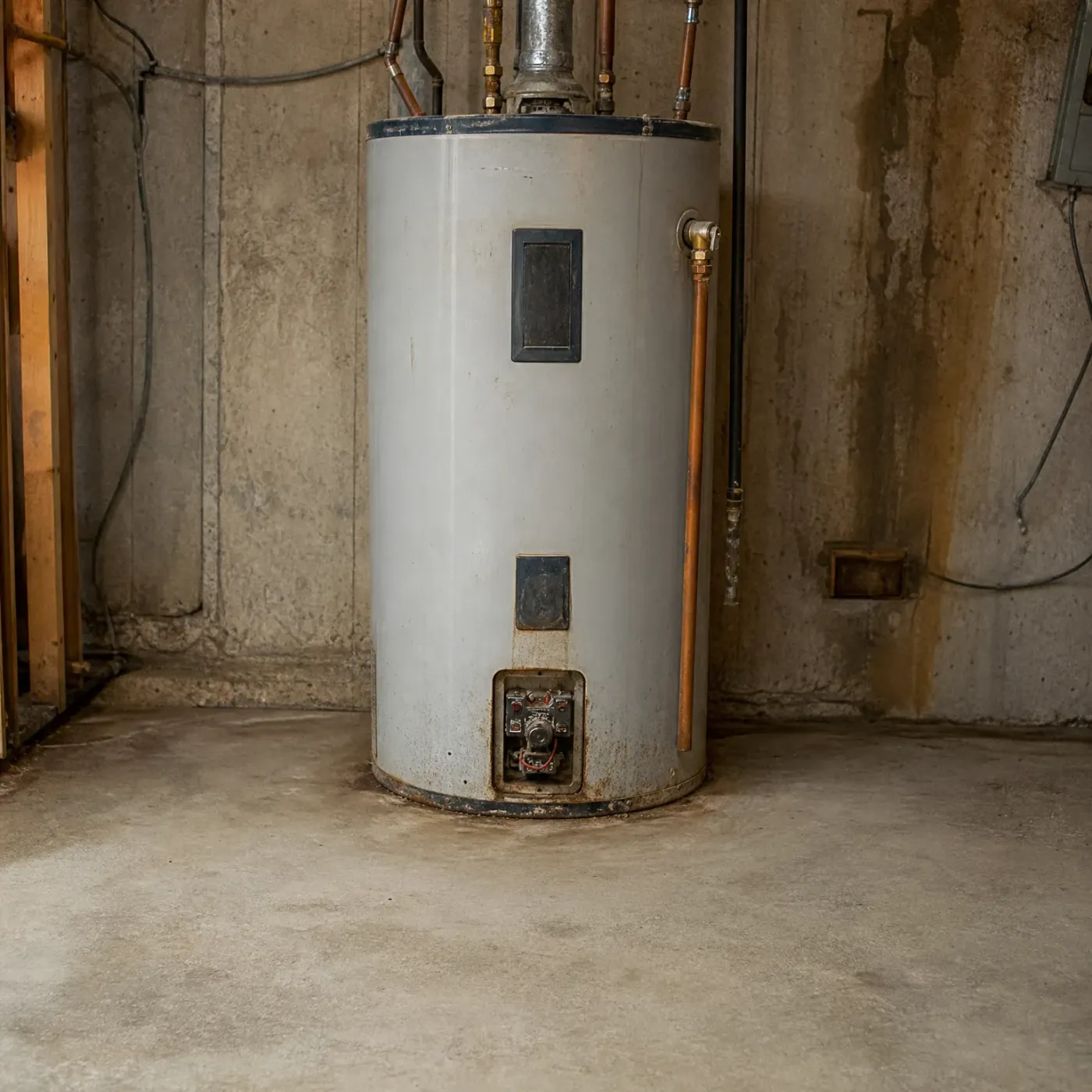
A tank like this one is past deciding. Rust on the jacket and at the panels means the inside is going the same way.
A tank water heater keeps a reserve of forty to fifty gallons hot all day, so there's always a supply sitting ready. How fast it bounces back after a long shower depends on the size of the burner or the element, not on how much anyone's using at once. A tankless unit skips the reserve. It sits idle until a faucet opens, then a sensor reads how much water is moving and fires the burner to match it. That's why gas tankless installs often mean new venting, the exhaust runs hotter than an old flue was built for. Electric tankless has its own hurdle: it pulls enough current that a lot of panels around Connecticut need upgrading first. Inside a tank, an anode rod is doing quiet work, corroding on purpose so the steel around it doesn't. A tankless unit has no anode, but it has a heat exchanger, and Connecticut's hard water will scale that exchanger faster than it would scale a tank, which is why it needs descaling on a schedule to keep the output where it should be.
How each one actually heats
A tank heater keeps forty to fifty gallons hot around the clock, so recovery time depends on burner or element size, not on demand.
A tankless unit fires only when a faucet or shower calls for hot water, and a flow sensor tells it how hard to work.
Gas tankless models need venting rated for their exhaust temperature, which is why swapping one into an old gas flue usually means new venting.
Electric tankless units draw enough current that most Connecticut panels need an upgrade before one can be installed.
A tank's anode rod corrodes on purpose, sacrificing itself to keep the steel tank from rusting through.
Hard water scales the heat exchanger in a tankless unit faster than it scales a tank, so the exchanger needs periodic descaling to keep output steady.
Picking between tank and tankless is only half the decision. The other half is finding someone who installs both correctly, pulls the right permits, and sizes the unit for your home instead of just swapping in whatever is on the truck. A tankless install usually means new venting and gas line work, sometimes an electrical update too, and that is not a job to hand to whoever answers the phone first. Calling around Connecticut for quotes, explaining your situation to five different companies, and trying to judge who actually knows tankless systems from who just installs tanks all day is time you probably don't have, especially with a water heater that's already failing. Send the request once and that search is over. You get matched with a contractor suited to the job you actually need, tank or tankless, and you go back to dealing with the rest of your day while someone qualified gets in touch about your water heater.
What a tank costs you in standby loss
A fifty gallon tank holds its water at temperature whether anyone showers or not. The burner or element cycles on through the night and through the day to cover that standby loss, and on a Connecticut power bill that adds up over a full year. Gas tanks lose less to this than electric ones, since gas recovers faster and the burner isn't drawing from the same expensive grid power. If your tank is electric, that standby loss is the main reason a tankless unit, which only fires when water is running, tends to close the gap faster here than it would in a state with cheaper power.
What tankless asks of your home first
A tankless unit needs a gas line sized for its burner, not just a line that happens to reach the spot, and venting rated for the higher flow and temperature it puts out. Where a tank vented into a shared chimney, tankless usually needs its own vent run to the outside. None of that is a problem for new construction, where the line and vent get planned in from the start. For a swap in an existing house, it's the reason a tankless install costs more upfront than it would if the infrastructure were already sized for it.
Power costs 29.31 cents per kilowatt-hour statewide
An electric water heater has no idle setting. It cycles to hold forty or fifty gallons hot all day whether you use it or not, and at 29.31 cents a kilowatt-hour that habit shows up on your bill every month, not just the ones you notice.
EIA-861 2025 statewide residential average
Tank or Tankless, Decided
A tank heater costs less to install and fits the gas line and venting most Connecticut homes already have.
A tankless unit costs more up front but stops the standby loss that shows up on an electric bill every month.
If the venting and gas line for a tankless unit already exist, or you are building new, tankless earns its keep faster.
If you are replacing a tank with another tank, the job stays simple and the install is quick to schedule.
A rusted jacket or wet fittings mean the decision is already made, whichever type you choose next.
Either choice depends on sizing the unit to your household, not on picking whichever type sounds newer.
Most Connecticut homes come out ahead with another tank. The gas line and venting are already sized for it, the install stays straightforward, and a straightforward install is one that gets scheduled fast instead of waiting on permit and venting work. Tankless makes sense when that venting and gas line are already there, or when the house is new and nothing has to be retrofit. Where that is true, skipping the standby loss an electric tank runs up every month starts paying off sooner.
What should not factor in is which type sounds newer or more efficient on paper. A tankless unit sized wrong for your household will short-cycle or run out of capacity during a shower. A tank sized wrong just costs more to run than it should. Sizing against how your household actually uses hot water matters more than the type on the label.
If the tank in your basement is rusted at the jacket or wet at the fittings, the choice is narrower than tank versus tankless. It is about getting a new one in before the old one fails and floods the floor around it. At that point the type you pick matters less than not waiting.
Either way, the harder part was never the decision. It is finding a contractor who installs both types correctly, pulls the permits a tankless retrofit needs, and sizes the unit instead of guessing. That is the part worth handing off.
Water Heater Installation
Let someone else find the pro
Skip collecting and comparing quotes for the new water heater.