Tell us about the job
Takes about a minute. No obligation.
A contractor diagnosing a water heater in this region starts with the combustion side: the burner orifice, the ignition assembly, and the heat exchanger. Fuel oil or kerosene heats more occupied homes in Northeastern Connecticut Planning Region, Connecticut than any other fuel, at 60.4% (2020-2024 ACS 5-year). Homes running on fuel oil or kerosene accumulate soot and combustion deposits at a rate that electric or gas units do not, and those deposits narrow flue passages and stress the heat exchanger over time. A repair quote that skips a combustion check is working with an incomplete picture of what failed and why.
Sediment at the bottom of a water heater tank does not announce itself until a unit starts failing, and in stock where plumbing has gone decades without a full flush, the buildup a contractor finds once the tank is drained often reframes the repair entirely. Half the homes in Northeastern Connecticut Planning Region, Connecticut were built in 1973 or earlier (2020-2024 ACS 5-year). A water heater sitting in a house that old has likely been fed by pipes with their own accumulation, and what looks like a failed heating element on the outside turns out, once the unit is open, to be a tank floor packed with mineral scale. That finding changes the repair scope: a new element dropped into a scaled tank fixes the symptom without addressing what shortened the element's life.
The Parts of a Water Heater a Contractor Checks First
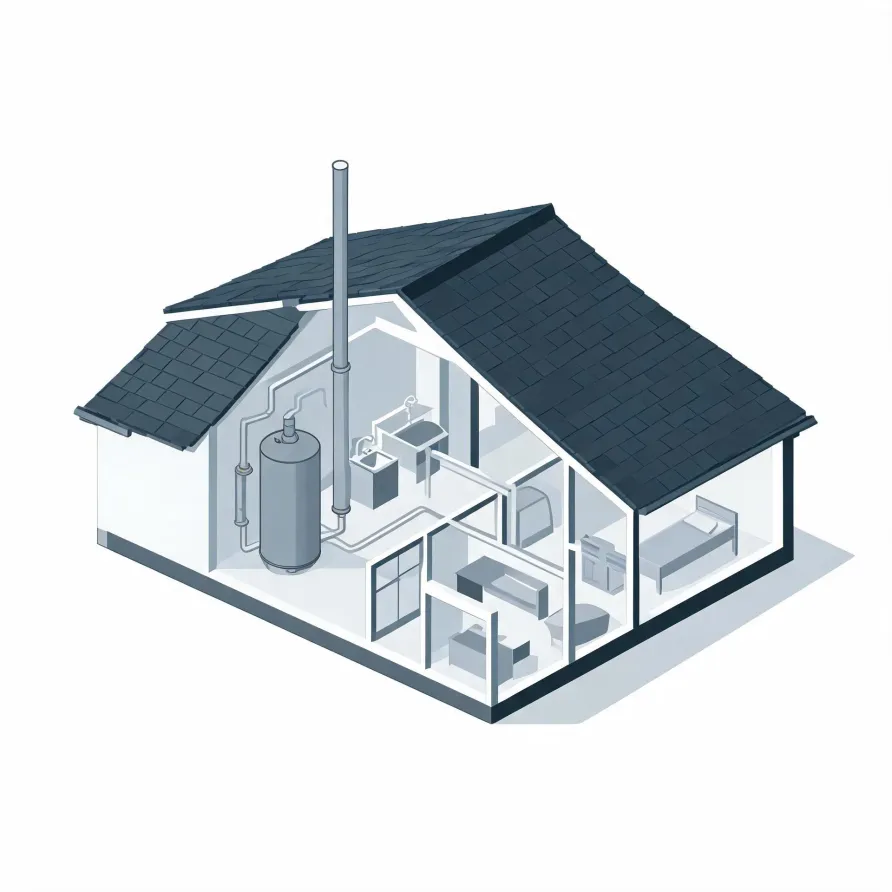
The tank itself sits in a utility room, basement, or closet and holds the water that gets heated and delivered to the rest of the house. The burner or heating element at the base or interior of the tank is what a contractor looks at when the water runs cold or uneven. The thermostat attached to the tank controls the target temperature, and a faulty one often mimics a failed heating element.
The pressure relief valve mounts on the side of the tank and opens if pressure or temperature climbs past a safe point. The anode rod runs down through the interior and slows corrosion of the tank walls. The supply and outlet connections at the top carry cold water in and hot water out to the rest of the house.
The drawing shows a general layout of these components, and a licensed contractor determines which of them apply to the specific unit in your home.
Find a contractor in Northeastern Connecticut Planning RegionNortheastern Connecticut Planning Region by the numbers
Half the homes in Northeastern Connecticut Planning Region, Connecticut were built in 1973 or earlier (2020-2024 ACS 5-year).
U.S. Census Bureau, 2020-2024 American Community Survey 5-Year EstimatesNortheastern Connecticut Planning Region, Connecticut holds 41,736 housing units (2020-2024 ACS 5-year).
U.S. Census Bureau, 2020-2024 American Community Survey 5-Year EstimatesOwners occupy 77.3% of the occupied homes in Northeastern Connecticut Planning Region, Connecticut (2020-2024 ACS 5-year).
U.S. Census Bureau, 2020-2024 American Community Survey 5-Year Estimates